

by Jessica Sawatski
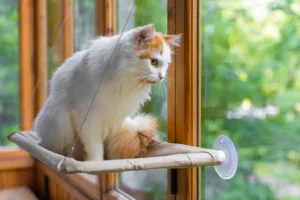
Tail flick. Ears forward. Teeth chattering at something you can’t even see. Your cat is locked in.
To you, it looks like idle staring. To them? It’s a full-on sensory event — suspense, strategy, stimulation. The window isn’t just glass. It’s access to a world that moves.
“It’s Basically TV.”
“A window is pretty much a TV with a warm spot for the cat,” says Dr. Leticia Fanucchi, clinical assistant professor of behavior medicine at Oklahoma State University’s Boren Veterinary Medical Teaching Hospital.
“Scientific studies show that visual enrichment, such as watching birds, people or moving objects, activates a cat’s natural hunting and surveillance systems, supporting cognitive health and emotional well-being in indoor environments.”
In other words: that sunny windowsill is doing real neurological work.
What They’re Actually Watching
It’s not random.
“Birds, squirrels, bunnies — cats are attracted to things in motion, especially if they can be hunted. This is basic predatory drive,” Fanucchi explains.
Translation? Movement + unpredictability = mental engagement.
Common Window Obsessions: Birds and squirrels, wind-blown leaves, insects on the glass, passing shadows, neighborhood foot traffic, other cats. Even shifting clouds can be enough.
Why Indoor Cats Need It More
Indoor life is safe. It’s comfortable. It’s controlled. It’s also limited.
“Visual stimulation is very important for all social animals, especially indoor animals who do not have much territory to explore, so any opportunity to interact with the world out there is enrichment,” says Fanucchi.
“Adequate visual enrichment has been associated with lower levels of stress-related behaviors in indoor cats by providing predictable, controllable sensory input that supports coping and emotional regulation.”
Positive Enrichment… or Frustration?
Most cats find window time calming. But not all do.
“It can be frustrating for some animals with anxiety because they simply cannot handle what they cannot control or get a hold of,” Fanucchi notes. “Overstimulation can be stressful for some cats.”
Good Signs: Relaxed posture, quiet focus, slow blinking, settling in for a nap afterward.
Stress Signals: Pacing, vocalizing, tail lashing, redirected swatting at other pets.
Balance matters. Windows should complement interactive play, not replace it.
Turn Any Window Into “Prime Real Estate”
The good news is you don’t need a remodel.
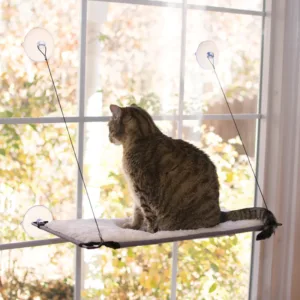
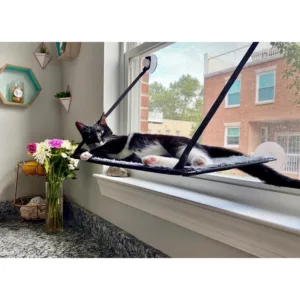
“There are several products out there such as window hammocks that have suction cups and attach to the window so the cat can lay on it comfortably,” says Fanucchi. “There are cat shelves that can be installed on windows and walls. But one can also place the cat tree right by a window.”
Where to Find Window-Watching Setups
If you’re looking locally, Southern Agriculture carries several window-mount perch options, including suction-cup hammocks and mounted platforms.
Easy Enrichment Upgrades
Add a suction-cup window hammock, position a cat tree beside the glass, install staggered wall shelves, place a bird feeder at a safe, non-frustrating distance, rotate outdoor visual elements seasonally. Even rearranging furniture to improve sightlines can make a difference.
Don’t Forget Comfort
Window watching isn’t always high drama. Sometimes it’s just about the sunbeam.
To keep it positive: make sure screens are secure, avoid overheating in direct summer sun, add soft bedding, keep drafts minimal. The goal is relaxed observation — not hypervigilance.
So, the next time your cat spends 45 minutes staring at a fluttering leaf, know this: They aren’t doing nothing. They’re hunting without hunting. Exploring without leaving. Engaging their wild brain — safely, comfortably, one pane of glass at a time.
Weight Math: Choosing a Safe Weight Limit for a Cat Window Perch
Always choose a perch with a weight limit that exceeds your cat’s body weight. As a general rule, the perch’s safe weight rating should be at least 1.3 times your cat’s weight.
Example: If your cat weighs 11 pounds, the perch should be rated for at least 14.3 pounds.
For added safety, consider a larger margin (1.5 to two times your cat’s weight) if: you have a large or heavy cat, your cat is especially active or energetic, or multiple cats may use the perch.
For multi-cat use, add weights. Don’t assume they’ll take turns. The minute a bird appears, two cats can try to claim the same seat.
Source: pawfectcatcare.com