Creating a home that is beautiful, functional and welcoming for both pets and people
by Jennifer Sharpe
Would a family with two kids and another on the way buy a home with only two bedrooms? Not likely. Yet many homeowners overlook the needs of another important part of the family: their pets. When planning a home, pet owners should consider how their animals will live, move and interact within the space.
Nearly 72% of U.S. households (95 million) own a pet, according to the 2025 National Pet Owners Survey cited in the American Pet Products Association’s 2026 State of the Industry Report.
Many of these households are making family decisions with their pets in mind, which even includes their home’s interior design.
“Your home should be as personal as your signature, and the design we do needs to reflect your own personal lifestyle,” said Kirkendall Design Founder and Principal Designer Julia Kirkendall. “When we’re designing homes, our vision is to design individually for each family. In today’s families, that incorporates a pet inside the home.”
Home design solutions that benefit humans can also benefit pets, Kirkendall said. “Pets are part of the family, so we need to consider their needs and design for them as well.”
Invest today, save tomorrow
Once regarded as a luxury, interior design is now being embraced by a broader audience for a variety of purposes.
“Good design can actually save you a lot of mistakes and money spent in the wrong ways,” said Kirkendall.
If family pets are considered from the beginning of the design process, you can avoid costly replacements in the future. The upfront cost difference can be minimal, but intentional design helps preserve your investment for years to come.
Getting started
Designing with pets in mind means thinking about the family unit and how it might change over time, including how many people and pets will live in the home today, five years from now or even 10 years down the road.
“We will design for the pets you have and the pets you want to bring into your life,” said Kirkendall, whose Tulsa-based studio has been in business for more than 30 years.
Whether building a new home or renovating an existing one, Kirkendall recommends thinking about how pets fit into everyday routines from the very beginning. Planning ahead can make it easier to incorporate durable materials, functional layouts and pet-friendly features that continue to serve the entire family as their needs evolve.
Smart and safe flooring
When it comes to flooring, designing for pets means accounting for safety, just like for people. Having non-slip surfaces and reducing tripping hazards are musts.
For carpets, choose options treated with stain-resistant technology that have low pile; the shorter fibers are easier to clean and less likely to trap pet hair and dander.
Laminate tile is relatively easy to clean and can withstand daily wear and tear, but it is not completely scratch-resistant or waterproof. Vinyl flooring can be waterproof and provide better protection against scratches.
For actual tile, Kirkendall recommends antimicrobial grout that won’t stain with pet urine.
Friendly furniture fabrics
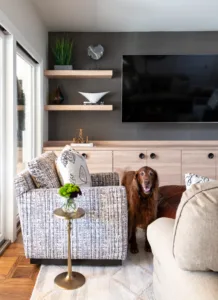
“When we are looking at new furniture pieces for clients, we need to look at pet-friendly fabrics,” said Kirkendall. “That means they’re dye-free, and they also do not hold fur or hair as well.”
Similar to carpet, choose options that are stain-resistant and can easily be cleaned.
Kitchen considerations
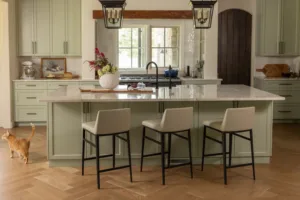
For many families, the kitchen is where everyone gathers to eat, pets included.
Kirkendall has designed kitchen cabinet layouts that include a feeding station for pets — at the end of an island or in the cabinetry that pulls out like a drawer.
For homes with cats, another important consideration is avoiding touchless faucets, Kirkendall said. A curious cat on the countertop could activate a touchless faucet simply by passing by.
Smart boundaries
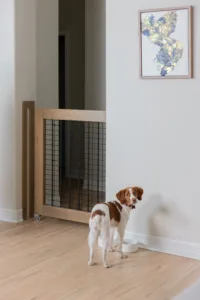
In many homes with pets, there’s a need to establish boundaries for where the animals can and cannot be.
In one recent renovation, Kirkendall’s team designed a dog gate that retracts into the wall, like a pocket door.
For smaller animals, such as hamsters or reptiles, the design process could incorporate how and where their cases are displayed.
It’s also important to design for the inevitable, when pets get out of their cages or cases, Kirkendall said. Measures like door sweeps and special locks have been used in those situations.
Having a space designed for your pet goes beyond a home’s interior. Outdoor living spaces are increasingly popular, and that applies to pets as well. Kirkendall suggests incorporating pet runs and using turf made for dog or cat urine.
A home for every family member
Whether it’s a built-in feeding station, a safe outdoor space or thoughtful storage solutions, designing with pets in mind helps create a home that works better for the entire family.
After all, pets are not just living in our homes — they are part of what makes them home.